Specialist study in creative media and production
My specialism is criminology and crime writing
Aim and purpose –
Designed for students to take greater control of their learning through independent research and presenting an investigation – This is key in relation to criminology.
What sort of research do we do currently?
As writers everything we do is a form of primary research as we are always learning new things. We use secondary research as we often write down information given to us directly from the internet.
- What interests you most about the subject – This can be related to professional life and what motivates you to do it
- Have SMART targets that aren’t too big and aren’t too narrow. Make them achievable.
The do’s of this project –
- Manage your time
- Utilise questionnaires effectively – even if they don’t work as planned
- Use a wide range of sources – ensure that Harvard referencing is used
- Structure your answers around your main findings
- Make sure the person that is reading your work knows what you are talking about. Structure the work effectively using headers and explanations as to what you are talking about.
- Every time you do research ensure you talk about the strengths and the weaknesses of that research.
Why do we research?
- To find things out
- To help tailor your own style – seeing what others have done to make ours unique
- To make our work authentic – readers will see through it
How do we research?
- Primary research – asking questions, questioners, polls, surveys, your own experiences. Where have you been? Who have you talked to? What do they know?
- Secondary research – The information other people have found and put out to the public via books and the internet.
- Quantative – Facts and figures
- Qualitative – The reasons behind the statistics
Why do writers do research?
Writers do research in order to find out information about what they want to write about. In a world where the internet makes information so accessible to everyone, a writer must have his facts straight and to the point to avoid cross examination. Sometimes a writer may simply write down things they see when going about their daily lives as it gives them inspiration for what they’re about to write.
How do creatives in general research?
Creatives in general use all the tools available to them to do research. With access to the internet comes and infinite amount of information which requires careful examination to get what you want. Creatives will often cross-examine themselves to ensure they have the correct data. When out and about creatives will take note of things they see that interest and inspire them. Sometimes simple things they see in the street will spark an idea that can lead to a great story.
How do we measure these?
Success – different people measure success in different ways, whether it’s having a happy, healthy family or lots of money
Pain – people in hospital are often asked to rate pain, but people have different pain tolerances so this is never accurate
The creative brain –
What different examples of creativity does the documentary identify?
What are the three key obstacles to creativity?
What can you do to overcome these obstacles?
What parts of the creative processes resonate with you?
I think the aspect of using failure as a springboard for success is my favorite aspect of the creative process. This is because it is something to relate to as not all my ideas work out.
Were you inspired in any way: how and why?
I enjoyed the director / prison teachers creative process of giving people a chance to express themselves, even when most people just define them by the crime they have committed. I also liked how the animator used a scrap book to inspire his creativity. I think this is a great idea as it gives an infinite source of ideas.
My Ideas of what I’m going to write –
Crime short stories –
- 1960’s gangsters
- 1980’s football hooligans
- corruption
- Audio book
You!
What has shaped you as a person?
There are a vast number of things that have shaped me as a person. I would say that my day to day experiences have shaped me as I’ve gone and will continue to do so. My parents have played a big part in making me who I am as I’m with them everyday, so I think some of their personalities have rubbed off on me. My passion for sport has had a profound impact on my life as it has enabled me to develop my social skills and make friends I would not have met without it. I have been able to become and integral member of a team and demonstrated leadership skills on a variety of occasions. Education has also shaped who I am today. Through school and college I have learned a vast array of key life skills that I will carry with me forever and met yet more friends who I see on a regular basis. Education has also helped guide me down the path to study at university which is huge step in young life. Finally, I think my current career in retail has had a big impact on me due to the demanding nature of the industry. I have improved my timings and developed a higher level of social skills to communicate with a variety of people. My tolerance of people has also got better and I am more accepting of some people who I would not have associated myself with before hand.
What influenced you and/ or has always influenced you?
I think travel is something that has always influenced me from a young age. As far back as I can remember, we’d always travel to other countries at least twice a year so I have experienced other cultures from a young age. Seeing how other people live and what’s the ‘norm’ in other places has had a profound impact on my life as it’s meant I’ve seen some amazing things that some people could only dream of seeing. Going to New York and seeing the lights and hearing the sounds will stick with me forever. Through all the glamour and money it was shocking to see the inequality between races in America. I witnessed an unacceptable amount of poverty for such a rich country which made me realize how fortunate we are in the UK. My appreciation for the world around me really stems from the time I went scuba diving in Egypt. I saw fish that I’d only ever seen on television and encountered an 10 ft long stingray that simply wowed me. For my future career in the police, I would say that crime documentaries have certainly influenced me as I took an interest in them from a young age. I enjoyed actively trying to solve the crimes along with the detectives and this has continued to where I am now.
Where can we look to find answers to questions? The art of noticing.
We can look to both the world around us and other people’s research to find answers to our questions. By exploring the world through travel and real life investigation we can find answers to things that other people do not know about. The internet and other reading resources are treasure-troves of information that are very easily accessible to most people. There are not many things that are not written about somewhere on the internet.
What primary methods of research are available to us and how do they help us create?
There are many useful forms of primary research. Internet surveys allow us to reach a wide amount of different people from around the world. From these surveys we can gather vast amounts of factual and statistical data which can be used as a basis for our creations. For example, if our hypothesis was ‘How often do teenagers spend on their phones per day?’, we could gather information via a survey and use it as a form of research to answer the hypothesis. Focus groups are another good form of primary research for discussing ideas and questions in small groups. Sometimes people might give you information or ask you questions you’ve never thought of before, so this could be highly influential when it comes to being creative.
Find something that interests you and ask: How did it get this way?
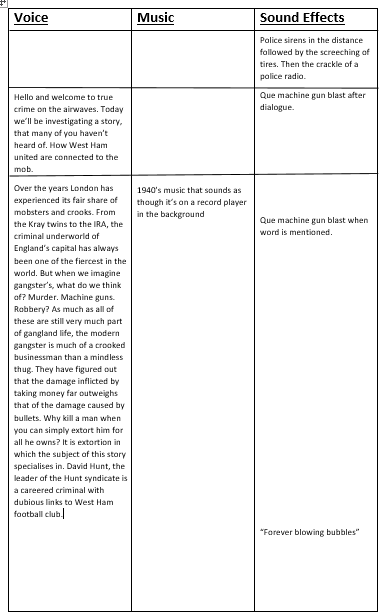
Policing and criminology is something that really interests me, hence why I am pursuing it as a career. I think the basis of my interest in this topic stems from watching police programs on television from a young age. I would say that as a young person I looked up to police officers as I was always taught that they were good people. As I’ve got older I have continued to take an active interest in the police, especially what happens in the news and the stories behind it. I have taken an interest in american policing as well, as they do the job in a completely different way. Since joining a creative media course at college, I have been given the opportunity to write a lot of criminology related stories and informational materials. I have studied what makes a good crime story by looking at examples of industry standard work, and analysed them for my own benefit. I have also taken a step into the unknown by using the radio studio to create a criminology related podcast. This required me to do much research in order to get my facts right. I listened to a few podcasts to get an idea of what it should sound like and was quite pleased with my finished product.
Question Brainstorm –
In this part of my research I will be listing down possible questions I could use for my hypothesis. (Red highlights are my favorite questions)
- How has crime writing changed over the past 100 years?
- How did ‘Sherlock Holmes’ change how crime novels are written?
- What makes the ideal crime story?
- What impact have crime documentaries had on crime writing in general?
- Are pre-television (documentary) crime pieces still viable in today’s market?
- What are the differences between 20th and 21st century crime pieces?
- How does police procedure influence modern crime writing?
- Do people still enjoy the ‘lone detective’ style of crime writing?
- How do modern crime writers tailor their work to today’s audience?
From this brainstorming session I have decided to use ‘What makes the ideal crime story’ as my hypothesis for this research project. I think my question can act as an umbrella to incorporate most of the above questions as well. Bringing them all together should give me a huge pool of research to use and make writing my pieces far easier.
My mind map
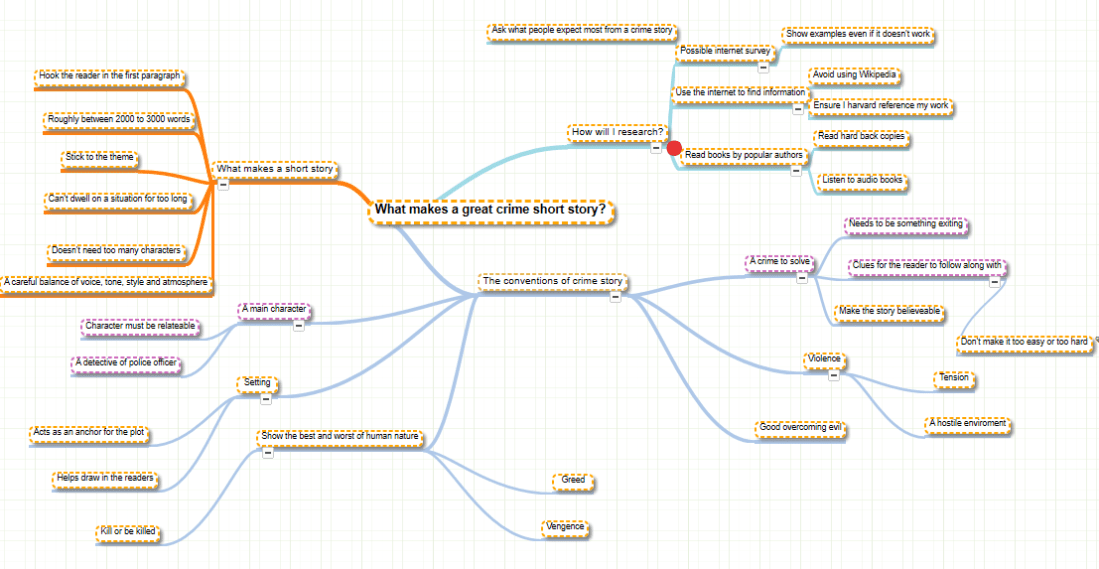
Analysis of 3 or more industry examples
The Big Sleep – Raymond Chandler
‘The Big Sleep’ is a crime/ detective novel written by Raymond Chandler. Set in a 1930’s Los Angeles, the novel is narrated by the main character Philip Marlowe. Marlowe is a private detective who has been hired to investigate a blackmail case relating to the death of a famous pornographer. His death has caused many other deaths. This is the first of two major conflicts throughout the novel. In the second half of the novel, the detective is concerned with the disappearance of another character. At the end of the novel, the detective is confronted by someone trying to kill him in an abandoned oil field. He uses this experience to put the pieces of the mystery together and solve the second major conflict. The main suspect is forced to confess and the mystery is solved. The entire novel is based around the theme of corruption and self-interest in 1930’s America. The novel is an example of a ‘hard-boiled’ detective novel. A ‘hard-boiled’ detective is someone that shows more masculine qualities than others. They can be compared to knights due to their motivation being personal honour and lack of respect for state justice. This is evident in the novel when Marlowe talks negatively about the police. According to online sources, “Often, critics compare the detective of hard-boiled fiction to a questing knight. Think of King Arthur’s knights, for example, who go on quests to find valuable objects (like the Holy Grail) or to slay a villain. The Holy Grail in hard-boiled fiction is usually the truth.”
Date of publication –
1939
Narrator –
The story is told from the perspective of the main character, Philip Marlowe, who is a private detective. Chandler deliberately gets into the mindset of a detective when writing this piece so that he can portray a believable character. The way in which minor details are analysed throughout clearly shows the reader that the narrator, a detective, is actively trying to solve the case whilst they’re reading.
Tone –
The entire piece has an underlying tone of darkness running throughout.
Tense –
Immediate past
My sources :
SparkNotes: The Big Sleep: Key Facts. 2020. SparkNotes: The Big Sleep: Key Facts. [ONLINE] Available at: https://www.sparknotes.com/lit/bigsleep/facts/. [Accessed 05 March 2020].
Encyclopedia Britannica. 2020. The Big Sleep | Introduction & Summary | Britannica. [ONLINE] Available at: https://www.britannica.com/topic/The-Big-Sleep-novel-by-Chandler. [Accessed 05 March 2020].
Study.com. 2020. The Big Sleep by Raymond Chandler: Summary & Analysis | Study.com. [ONLINE] Available at: https://study.com/academy/lesson/the-big-sleep-by-raymond-chandler-summary-analysis.htm [Accessed 06 March 2020].
Real Detective documentary – Episode 1 (Netflix)
Reliving the hunt for a serial murderer in Seattle, Washington in 1997, Real detective uses dramatic depictions of events to hook the viewer and reel them in to what they are watching. The narrator is the detective who worked the case and therefore is able to give the viewer inside information. The recreations are filmed using actors who seem to follow police procedure throughout, allowing the viewer to become immersed in what is going on in front of them. I believe that the narrator is the key to this being an effective documentary as we as viewers are able to respect his opinion a lot more in comparison to if it was just a random voice telling the story. The detective deliberately goes through the questions he was asking himself at the time, which gets the audience thinking. He doesn’t always answer the questions straight away which again hooks you and reels you in as you’re constantly thinking about what the answer to the question would be.
In terms of police procedure, the filming begins with the detective and other officers cordoning off the area in which the body has been found. The examine the body for obvious clues and make preliminary presumptions about what has happened. They then question potential witnesses at the scene before the footage cuts to the detective at the medical examiners office. Here, the medical officer reveals the name of the victim through the use of finger prints and they discuss how the person died and what injuries were caused. The next step of the journey takes us to see the victims grieving family. The detective and his partner question the boyfriend and mother of the victim to try and establish some clues, and to try and see if either of them might have been involved. The detective tells us “I think my partner and I developed a relationship with Denice (The victim)”, which I think is very interesting. Through investigating every aspect of this woman’s life, they have got to know her almost as well as if she were still alive. I think this is lacking in many fictional crime stories in which the detective is commonly very detatched from the victim. One of my favourite parts about this program is that it constantly takes us back to the detectives office and shows the discussions between the him and his partner. It shows that he is not alone in solving this case and relies on the ideas and theories of others to help him.
Finally, the prison interview in which the detective finds out who the killer is is absolutely perfect. The person who plays the criminal gives off the perfect vibe of a shifty individual who knows more than he lets on. The acting throughout is great and puts us very much in the moment that this is all happening. The ending is shocking and we finally get to answer the questions that the detective was asking himself from the beginning.
When it comes to writing my own pieces I definitely think I will use aspects of this documentary in my writing. I like the fact that the detective works closely with a partner who he can bounce ideas off of, therefore not making himself seem like the sole hero. I think I will also use a scene like the one where he is visiting someone who is already locked in prison. The mental battle between the detective and the criminal trying to play each other is fascinating as it is completely unpredictable and makes the viewer want to keep watching in order to see who comes out on top.
Real Crime – Diamond Geezers (2008)
Producer – Tom Whitter
“In an attempted heist worthy of a Hollywood film, a cadre of criminals sets out to steal the worlds largest perfect diamond from a London landmark”.
Based on a real event that made headlines around the world, this documentary uses exclusive police footage and dramatic reconstructions to tell the story of one of the worlds largest attempted heists. Along with a primary narrator who tells us what is going on throughout, this program makes great use of eye witness statements and interviews to give us inside knowledge of what really happened. The chief officer in charge of the police operation is one of the most informative witnesses used. He tells us all about how they caught wind of what was happening and demonstrates some of the police procedure used at the time. This information all contributes towards one key factor. Trust. When a viewer trusts the reliability of the sources used in a production then they are far more likely to read or watch on. For someone like myself who wants to know that what I’m watching is realistic and minimally staged, it is great to see.
There are many aspects of this documentary that I may add to my writing, The use of the police planning board in which they are putting pins in order to try and plan where the next robbery may be is a great scene. I think that I could use this to create a great image for my readers in which my character and his partner are trying to solve a case. It would really put my audience in the room with the detective and they could try and solve the problem at the same time.
My Interview attempt with an Ex Police officer –
As one of my research methods I chose to send out some questions to an ex police officer. I believe that interviews are a very important form of research as they allow me to get inside the mind of an actual person who has experience in the field of what I am going to write about. Here is what he said –
As an ex police officer, would you say your career was as action filled as books and television series make it out to be?
In the last half of my career yes I would. This is because I was an Armed Police Officer on the Kent Police Armed Response Unit.
Walk me through a typical case, how is it solved and who is involved in doing so?
Depending on the severity of the case, generally you would have an initial response from the patrol officers. If an offender gets arrested then they would be taken into custody where they would be dealt with by a Custody Sergeant. Whilst there they will have their fingerprints and DNA.
They would then be interviewed, possibly by a Detective. If there is any types of forensic evidence, the then the CSI would be involved.
If they are charged they will then be charged and given a court date. If the offence is serious the offender may wait in custody and have to be taken straight to court. This is done by an independent company called Serco.
Once at court, they will be delivered to the cells where they will be handed to the court custody staff.
They will then be taken into court and put before a Judge or Magistrate.
A lot of this will be determined by the severity of the crime that has been committed.
Do you think the public would find how a crime is actually solved interesting, or do the more action filled interpretations do a better job?
I think that the public would prefer the action filled interpretations.
What is the most interesting crime you have ever been involved in?
The most interesting crime(s) I have been involved with have been shootings and County or National organised crime.
Do you think the media portray the police in a fair way?
No not really. I think that the Police are given a bad reputation.
Do you watch or read any particular crime series that you think are realistic?
I do like to watch true crime documentaries on the television.
From the questions I have asked, I feel I have gained some insight into the mind of a police officer. This will come in use when I am writing my final pieces as I can use the information I have learned to make my characters and scenes more realistic. Being taken through the process of a typical case is very useful as I feel it will add realism to my story. The element of police procedure will enhance my writing, and hopefully be a benefit to my readers.



 ArchieHall Journalism